
From AI Talk to AI Colleagues: Emma van Dijk on What’s Really Changing
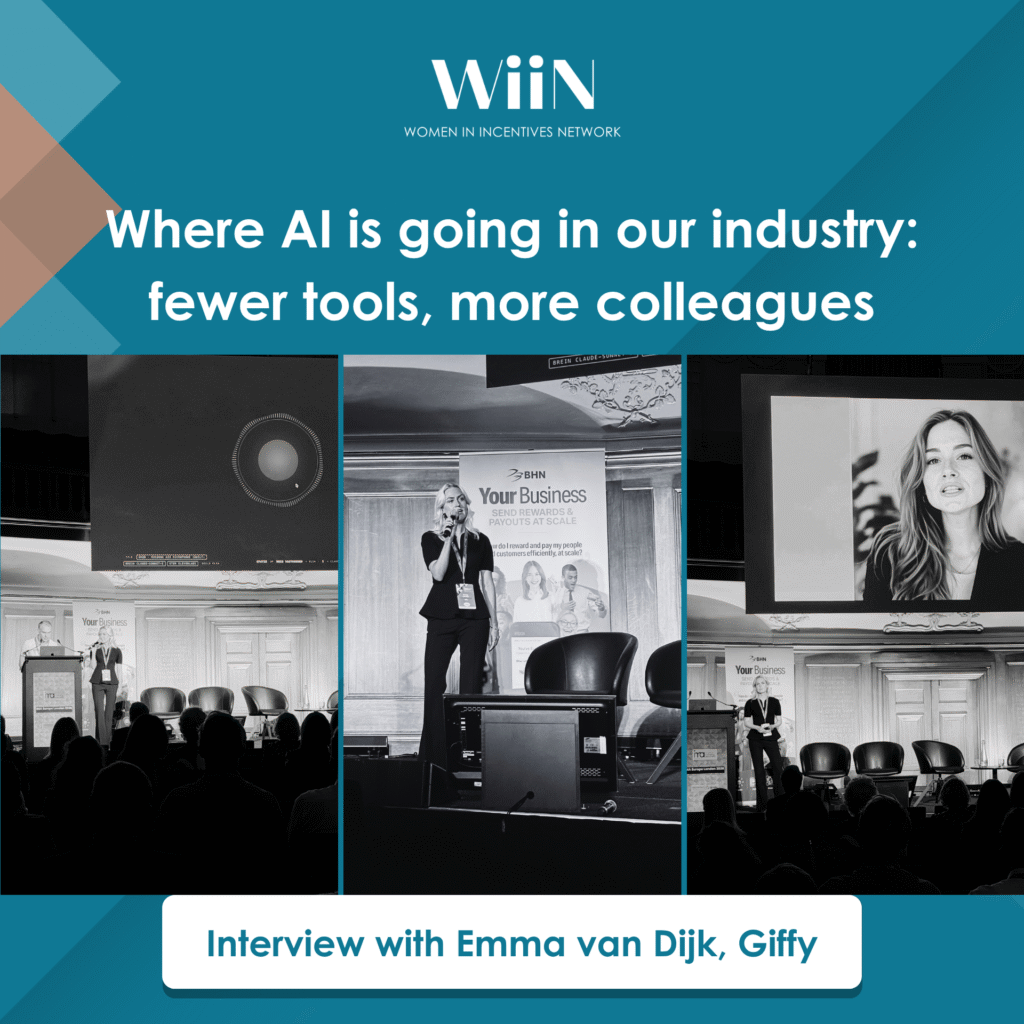
Emma van Dijk, Growth Marketing Manager at Giffy, recently took the stage at IMA Europe in London alongside two AI “colleagues” to show the audience what AI agents can actually do — live, unscripted and based on Giffy’s real-world experience.
We caught up with Emma afterwards to hear more about her experience, what she shared, and what she thinks the incentives and rewards industry should be paying attention to.
Emma, for those who don’t know you yet, could you introduce yourself, your role at Giffy, and what Giffy does?
I’m Emma van Dijk, Growth Marketing Manager at Giffy. Giffy is a Dutch rewards platform for companies: employee rewards, sales incentives, referrals, year-end gifts and loyalty programmes.
What makes it work is choice. The company sets the budget and the moment, and the person receiving it decides what it becomes.
My role covers everything on the demand side: positioning, campaigns, landing pages, SEO, ads and reporting.
What changed is that a good part of that work is now done by agents, and I’m the one who teaches them. The structure is simple: Claude designs and writes them, Elsa runs them every day. Claude builds, Elsa does. That split is the whole thing.
I’m not a developer. I’m a marketeer who learned to explain her own job clearly enough that software could take parts of it over.
You recently presented at IMA Europe in London. What was it like being on stage?
Exciting beforehand, genuinely enjoyable once I was up there. I felt at ease faster than I expected.
The room was completely full and the attention was remarkable. At some point I saw people reaching for their phones to take pictures and film parts of it, and that’s when I knew it was landing.
What stayed with me most was afterwards. Messages on the day, the day after, over the weekend, and people are still writing now.
Several people said the same thing: it was the first AI session they’d seen that showed something running rather than something planned. One person told me they went straight back to the office and listed every task their team repeats each week.
That’s exactly what I’d hoped for.
What made you want to do this presentation, and why did you feel this was an important topic for the incentive and rewards industry right now?
Because almost every AI talk I’d seen was about what’s coming. Slides, predictions, a roadmap for 2028.
Meanwhile, we had something running at Giffy every single day that nobody was talking about honestly.
So we did it the other way round. Pascal and I didn’t give a presentation about AI. We brought our AI colleagues on stage and had a conversation with them in front of the room, live, with nothing scripted.
Elsa, our agent, and Claude, who builds them. Four of us on stage, two of us people.
Why it matters for our industry: we’re a sector with big ambitions. Every growth step used to mean another hire, another three months of waiting, another job description.
That maths has changed, and a lot of people haven’t noticed yet because the conversation is still stuck on chatbots.
AI is such a broad topic. What specifically did you focus on, and what do you think people often misunderstand about it?
We focused on one thing: the work that repeats every week.
Not the clever work, not the creative work. The reporting, the checks, the monitoring, the first drafts. The work that never makes it to the top of a Monday.
The honest answer starts with what I’m not. I don’t have an SEO background. I don’t have a Google Ads background. I have a general marketing background, which is true for many marketing people in our industry.
So the hard part for me was never the strategy. It was the data: getting the right numbers, making the right call, and explaining to the team how we’re performing and what we need to fix.
That part is now AI, and I genuinely don’t worry about it any more. My agents have the expertise I don’t have. One of them knows how to read a Google Ads report properly. One knows how SEO scoring actually works.
The biggest misunderstanding I hear is that AI is a tool you buy, a subscription with a chat window.
What changed everything for us was treating it like a colleague you onboard. You explain the job, you give feedback, and it gets better because you taught it.
If you can brief a new colleague, you can brief an agent. That’s the whole skill.
If you had to give the WiiN community your three biggest takeaways, what would they be?
One: Start with what repeats, not with what’s hard.
The first thing we built was an SEO agent, which we immediately made a GEO agent too, because more and more people ask an AI instead of typing into Google. If you’re not in those answers, you’re not in the conversation.
It runs on its own and there’s a report waiting every week. Before that, nobody at Giffy was really watching it. Not because we didn’t care, but because it’s exactly the kind of work that never gets to the top of the list.
Two: The feedback loop is the product.
An agent that gets corrected once and remembers is worth more than a clever one nobody adjusts. Everything ours do well today is something somebody explained to them at some point.
Three: Put your limits in code, not in a policy document.
A policy is a promise. Code is a fact.
Our agents can move the budget between campaigns, but they cannot change the budget itself. That isn’t written down somewhere hopeful — it’s built in.
Was there anything you shared at IMA that really made people stop and think?
When we asked Elsa live what I had taught her that week, and she answered in her own words.
The room went quiet.
Not because the answer was spectacular, but because everyone realised nobody had written it.
For the WiiN community, people working across incentives, rewards, loyalty and recognition, what should we be paying particular attention to when it comes to AI?
The thing is where you draw your line.
Ours runs between routine and new.
Routine work the agents simply do: nobody needs to approve the weekly SEO report or the daily check on the ads.
New things are different. If an email is going out to people, I want to have read it first.
Google Ads is the clearest example: they can move budget between campaigns, inside what’s already there, but they cannot change the budget itself.
They have room, but they don’t have the key.
If someone thinks, “I know I should be doing more with AI, but I don’t know where to start,” what’s your best practical advice?
Pick the task you do every week and like the least.
Not the biggest problem in your company — the small, repeating one.
Then write down what “good” looks like, as if you were briefing a new colleague who starts Monday.
What does the output contain? What does it never contain? Who reads it?
That document is the actual work. The tooling is the easy part.
Then give feedback every week, even when it’s right.
We started literally on Pascal’s laptop with one question: which things do we repeat every single week?
Everything we run today grew out of that, not out of a strategy deck.
People often ask what keeps me up at night. Honestly, nothing any more. We build these ourselves, and an agent does nothing except what we asked it to do.
What we did have to fix was hearing about it when something goes wrong, so there’s an alert in Slack now the moment something breaks.
What actually keeps me awake is how much further we could take this.
And don’t wait until you feel technical enough. You won’t.
The people in our industry who understand recognition, loyalty and what moves people are exactly the people who should be shaping this.
Looking beyond the technology itself, how do you think AI will change the way we work and create value in our industry over the next few years?
I think agents will get more room to act.
Right now ours ask permission for things they’ve done correctly fifty times in a row.
That isn’t safety, that’s a queue, and I’m the queue.
So the next step is clearer limits rather than wider ones: their own space to act, their own budget they cannot exceed, and a human only where it genuinely matters.
What that changes is what our jobs are.
Less collecting, more deciding.
I don’t start my week gathering data any more. I start making calls.
For our industry specifically, I think the value moves from logistics to attention.
Rewards happen in December because that’s when someone has time. There’s no reason for that any more.
The moment can find the person: the quarter they saved, the anniversary nobody remembered.
Same budget, same rules, and suddenly it feels like someone was paying attention.
Finally, if someone in the WiiN community wants to explore this topic further or learn from what you’re doing at Giffy, how can they connect with you?
Find me on LinkedIn — I answer everything.
Foxwork is here to help other teams build what we built at Giffy. Everything we showed on that stage came out of our own practice, including the parts we got wrong first.
For WiiN and IMA members, we’re offering a free 30-minute session. Consider it our gift — we’re in the incentive business after all.
foxworkai.com
Book a slot: cal.com/pascal-van-dalen-pokptx