
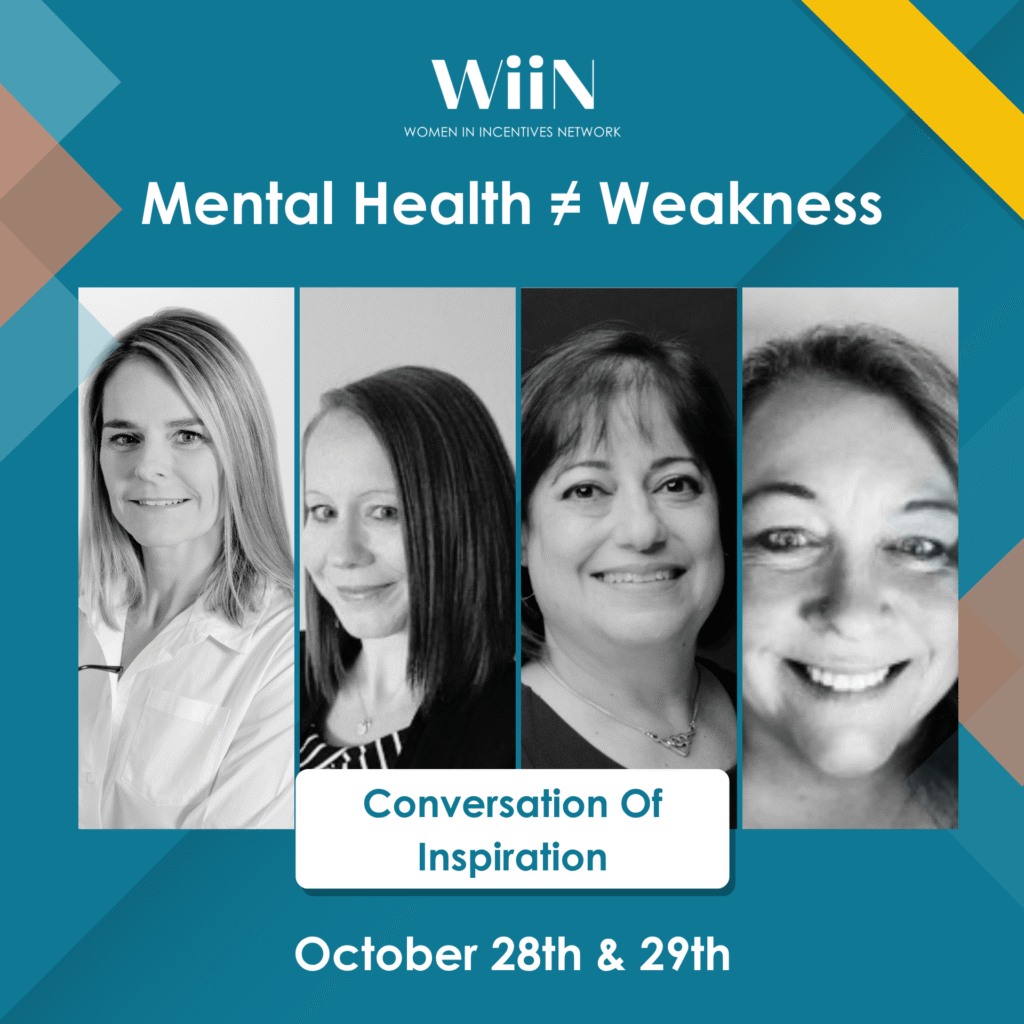
Rewind Recap: Mental health is not a weakness
When the conversation turns to mental health, even the most confident professionals can falter. It’s not always easy to speak up, especially in industries that reward performance, composure, and control.
To open this dialogue, WiiN hosted a webinar session.
Psychologist Jane Viljoen and Amanda Et-Tibary opened the conversation: what mental health looks like in fast-paced workplaces, how toxic dynamics chip away at confidence, and the habits that help us recover.
Julee Schmaus and Kathy Heath took us further, normalising medication and therapy when they’re needed, unpacking the “superwoman” myth, and showing how self-talk retrains the brain.
“It’s important to realise that as women, we are not superheroes, and we can’t always do it all by ourselves.” — Julee Schmaus
Julee described the moment her “do-it-all” routine collapsed under years of unacknowledged pressure. A routine surgery triggered a spiral into clinical depression — something she later learned ran in her family. Eight weeks on antidepressants and consistent therapy helped her find stability.
“My doctor said, you wouldn’t withhold insulin from a diabetic. There was something off in my brain, and the medication was there to level-set.”
Her recovery also required a reckoning with self-neglect and a toxic workplace she’d been prioritising over her health. Leaving that job became her first act of healing.
Kathy’s story echoed the same truth from a different angle — burnout rooted in bullying and relentless self-doubt.
“I remember driving to work and thinking, I just want to drive this car off a cliff. The counsellor was the one who told me I was being bullied. Medication worked, and then I learned to reprogramme the limiting beliefs.
Her turning point came through therapy and later, life-coaching.
“Your brain believes what you tell it. If you tell it you’re rubbish, it will believe it. If you tell it you’re great and that failure doesn’t exist, it will believe it.” — Kathy Heath
Both women now use their experiences to remind others that medication and mindset aren’t opposites — they’re tools that work together. As Julee put it: “It’s okay not to be okay.”
What the science says
Jane framed the discussion by noting that everyone has mental health, just like physical health. It naturally fluctuates, influenced by genetics, environment, and lifestyle.
She highlighted that:
- Stress rarely stems from one cause — it’s usually a mix of triggers.
- A lack of psychological safety at work erodes wellbeing.
- Movement, rest, and nutrition are not luxuries; they’re the baseline for mental stability.
The brain operates in three zones
- Green – calm, content, and focused.
- Amber – processing and interpreting meaning.
- Red – overwhelmed or panicked.
Even small triggers — a comment, an email, a meeting request — can shift us out of green. Our brains instantly compare new experiences to old memories: Am I safe? Am I valued?
Every emotional spiral starts with a thought, even when we don’t notice it. Thoughts like I’m being criticised, I’m not good enough, or I’m rejected spark feelings — dread, guilt, defensiveness — which then drive behaviour. We might snap, retreat, or over-explain without realising why. Recognising this loop lets us step back and choose a different response.
In practice: break the cycle
- Trigger: “Have you got a minute?”
- Auto-thought (often subconscious): I’m in trouble.
- Feeling: Dread, tight chest, adrenaline.
- Behaviour: Defensive tone or curt reply.
- Reinforcement: “See? They were annoyed.” (The loop strengthens.)
Interrupt it: Name the thought, breathe, and swap in a green-zone question: What else could this mean? What outcome do I want? Then choose a neutral opener: “Sure — what’s the focus?”
The submarine analogy
Jane likened the brain to a submarine:
- The captain (conscious mind) gives orders.
- The engine room (subconscious) obeys without question.
If we say, “I can’t cope,” the engine room releases stress hormones like adrenaline and cortisol. If we say, “I’ve got this,” it keeps us steady. The takeaway? Our self-talk programs our chemistry. As Jane put it: once you understand your triggers, you can build a kind of mental force field to return to calm faster.
The chemistry of connection
Our brains aren’t static; they’re chemical factories. Connection, affection, and purpose release oxytocin, serotonin, and dopamine — the “feel-good” trio. Stress floods us with cortisol and adrenaline, which block these benefits.
When stress dominates, we don’t want to move, eat well, or socialise — yet those are the very actions that restore balance. Jane encouraged small, intentional acts of movement or gratitude to gently shift brain chemistry back toward calm.
Ask those green-zone questions that direct attention to solutions:
- What do I need right now?
- How can I be a good friend to myself?
- What’s within my control?
When teams share the strain
Edda raised a common challenge: “What if it’s not just you? What if your whole team is under pressure?”
Jane agreed that collective stress can trap everyone in protect mode. Her advice: start by asking green-zone questions of others — simple, open curiosity like What do you need right now? or What’s worrying you? builds psychological safety and reconnects teams that have lost trust.
Women, she added, are often trained to mute this instinct. “We adapt, we over-deliver, we fit in. But intuition is a biological strength — our built-in radar for safety and alignment.”
When the past pops back up
An audience question asked whether old relationship trauma can resurface years later. Jane’s answer: yes — experiences get “filed” in the brain and can be reopened by new triggers. It can help to safely “unpack the drawer” with a trusted person or professional.
Christine offered a helpful analogy: after a major event, you may still experience occasional “mini-strokes” — brief echoes (PTSD-like flares) that make sense when you recognise the link, validate the feeling, and then use your tools to move on.
The five pillars of happiness
To close, Jane introduced a model from positive psychology: five evidence-based pillars of wellbeing. She urged everyone to identify one pillar they could nurture this week.
- Positive emotions – practise gratitude and self-affirmation daily.
- Engagement – do something absorbing: paint, knit, run, garden, write.
- Relationships – prioritise time with people who restore you.
- Meaning – connect to something bigger: mentoring, volunteering, purpose-driven work.
- Accomplishment – celebrate small wins; they train the brain to notice success.
“We wear too many hats trying to be superwoman,” Jane said. “It’s impossible. Start with what matters most to you.”
20 takeaways from Mental Health Is Not a Weakness
- Everyone has mental health — it naturally fluctuates.
- Toxic environments can erode confidence quietly over time.
- Leaving is sometimes the first act of healing.
- Awareness is the bridge between reaction and recovery.
- Psychological safety isn’t optional; it’s oxygen for teams.
- The thought always comes before the feeling — catch it early.
- Negative self-talk trains the brain for stress.
- Language matters. “Don’t panic” still tells the brain to panic! Swap negatives for affirmations: “I am safe. I can handle this. I know what I’m doing.”
- The body’s chemistry follows your language.
- Fight, flight, freeze, or appease — notice which one you default to.
- Oxytocin thrives on connection; cortisol thrives on chaos. Choose connection.
- Small, physical actions (breathing, walking, swimming) reset your chemistry.
- Gratitude is science-backed — it literally alters your brain’s wiring.
- You can’t think clearly when you’re in defence mode. Step out, then decide.
- Curiosity heals teams faster than criticism.
- Intuition is data. Pay attention to it.
- “Pay attention to the tension” — your body knows before your mind does.
- Self-coaching questions open the door to clarity.
- Share your story; silence breeds shame.
- Happiness isn’t constant. It’s a practice of noticing, choosing, and rebalancing.
The session closed not on perfection but perspective.
As Jane reminded the group:
“We can’t control every wave. But we can learn when to come up for air.”
___________________________________
Written by Elaine Keep www.elainekeep.com